

07.08.2025 - 02:00
|
Actualització: 08.08.2025 - 15:53
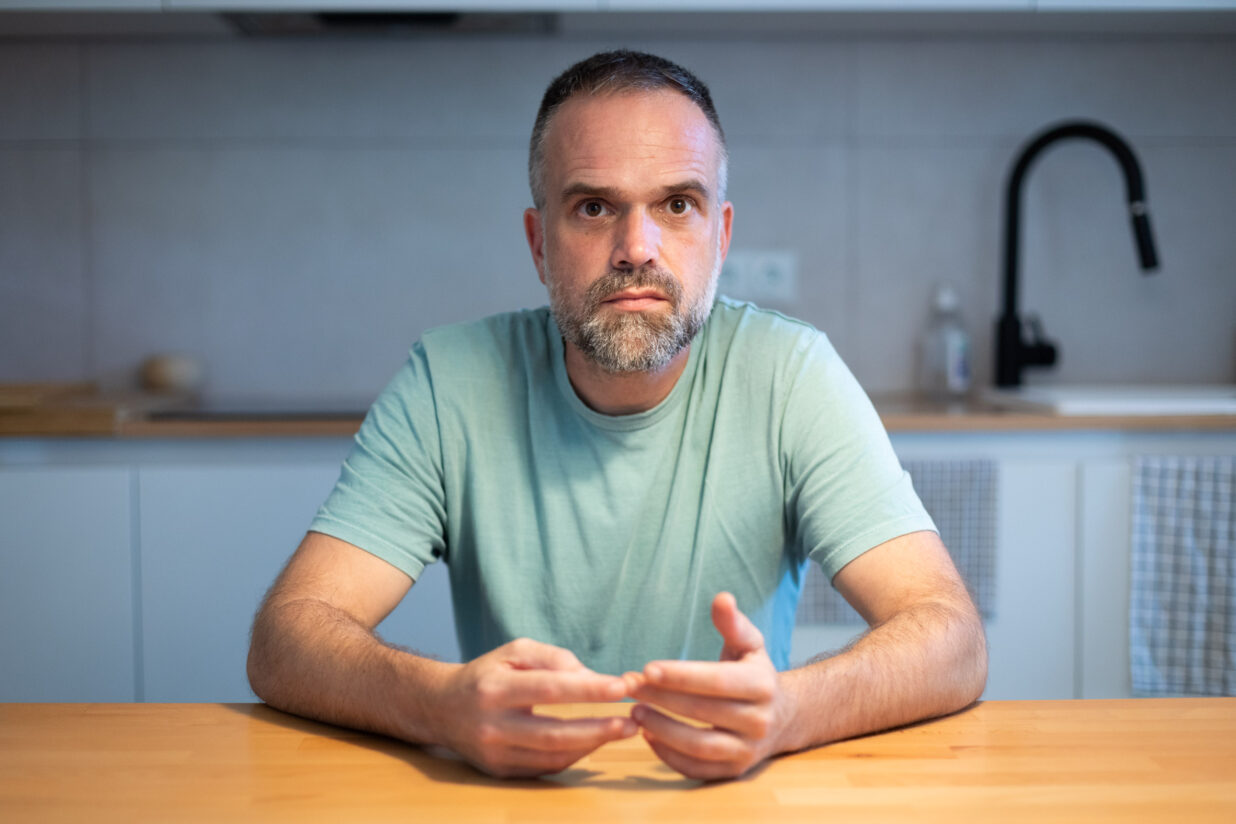
A week ago he landed in València and hasn’t stopped giving interviews. He feels it is his duty to explain the situation in Gaza, which he describes as hell. Anesthetist Raúl Incertis welcomes us at his home in the Benicalap neighborhood of Valencia. Here he has been able to rest and sleep—something he’s grateful for after four months as a volunteer with the NGO Glia at Nasser Hospital in Khan Yunis, the only hospital in southern Gaza. The hospital is not a safe place either. During his stay it was hit six times. This hospital, with a capacity of 270 beds, must now treat over a million people in inhuman conditions. Incertis speaks calmly of things that are hard to imagine. “In a scenario like that, you either dissociate or you can’t work,” he says. Now he asks only that people continue talking about Gaza.
—After four months in Gaza, you decided to return. You said you were mentally and physically exhausted. How are you now, one week later?
—Good, because it’s as if I’d been released from prison. It’s a horrible place. Now I can rest, find food in the fridge, and I don’t have children or patients to care for, but I also feel deep sorrow for not being there with my colleagues.
—In fact, you went to Gaza for what was supposed to be a one-month volunteer stint, and you stayed four months. Why so long?
—Because of the constant need. There were many mass-casualty incidents every day, which made the work unending. Also, my colleagues greatly value having foreign doctors. Among themselves they seldom complain, because they are all victims, but with foreign doctors they would share what their lives were like before. They’d show us their phones: “This was my house, these were my children who are now dead.” We saw that our presence, beyond medical care, provided companionship and support, and I wanted to be there with them.
—What was your daily routine like? It’s hard to imagine the situation…
—It’s a 270-bed hospital with a few pavilions, but it’s running at 200% capacity. It was completely full, and wounded people kept coming in nonstop. In the first two months, there weren’t that many. But after the opening of the Gaza Humanitarian Foundation’s food distribution, organized by Israel and the U.S., mass-casualty events, which before happened two or three times a week, occurred every day, sometimes several times a day. In the emergency department you saw civilians mutilated, mostly under twenty years old—many fifteen- or sixteen-year-olds, and even children aged five or six, babies as young as a month old. They’d be pierced by shrapnel, with chest, abdominal, or head perforations—sometimes brain matter exiting—amputations, burns, crush injuries… And it was constant. Many bodies arrived too, which went straight to the morgue. You couldn’t stop. Families were frantic, parents crying. You stabilized those who could be stabilized, and then—if they made it—you took them to surgery. It became a problem when the ICU filled up after about six weeks; they had to open secondary ICUs, which also filled up. Many times you had to choose which child to intubate and send to the ICU and which to let die, because there wasn’t enough space. That happened constantly. And it worsened greatly when attacks occurred during food distributions. The numbers then shot up.
—This 270-bed hospital must care for over a million people. Can you work under these conditions?
—Very poorly. You’re utterly exhausted because so many patients arrive and they’re all alike—you see the same horror over and over. Sometimes you have to put two, three, or four children on one stretcher because there aren’t enough. You trip over patients lying on the floor in the corridors and courtyards. The hospital had about seven hundred inpatients. My colleagues work very long shifts—sixty to seventy hours a week—and they live in makeshift shelters. After work they must fetch flour, water, firewood. And then there’s the lack of supplies. Last week they ran out of gauze and dressings, so they couldn’t treat wounds properly; there was no fentanyl for surgeries, so we performed major operations with just three milligrams of morphine. For postoperative pain there weren’t enough drugs, so patients suffered terrible pain. There weren’t enough antibiotics, and there was no infant formula for the neonatal ICU. Everything was awful. There were critically ill patients whose legs we had amputated or whose skulls we had opened to evacuate hematomas, and we had only ketorolac, diclofenac, or IV ibuprofen because there was no morphine. During surgery they didn’t realize how much pain they were in—they were sedated with gases—but afterward, the pain was immense.
—You lived at the hospital. I imagine you were in a constant state of alert…
—Yes. You never rest. When you try to sleep an alarm for a mass-casualty incident sounds. At night the workload is heavier because they bomb the so-called “humanitarian zone,” the area people were told to evacuate to for safety—but they bomb it too. Every night we received one or two families bombed while seeking refuge—children killed or injured. I lived on the same floor as the ICU and operating rooms; I couldn’t leave the hospital. In the last month and a half I did take a day off now and then and rested at the NGO’s house. Going outside is very dangerous. If you step into the street you know a bomb could fall on you, because they shell around the hospital. You’re tired of being confined to the same place. Moreover, the hospital is full of displaced people and refugees; there’s nowhere to be alone. You have to hide in the bathroom for just five minutes.
—Is the hospital safe?
—No, it isn’t safe. It was attacked six times while I was there: two airstrikes, three militia attacks—one by an Israeli-paid militia using Israeli drones—and, finally, Israeli soldiers opened fire on the hospital, killing one man and seriously wounding another. Previous attacks killed others. People feel the hospital is safer than the street, but they know it can be hit at any moment.
—You describe the whole thing as hell?
—Yes, it’s hell. Everything is razed. Very few buildings remain standing in central Gaza. It’s like five atomic bombs fell—but in pieces. If you total the explosive weight of the more than 100,000 tonnes of bombs dropped on Gaza, it’s more than five Hiroshima bombs. What you see matches that: it’s utterly devastated; nothing remains.
—You talk about patients of all ages, but you especially emphasize children…
—Because that’s what affects you most. A violent death should never occur, but a violent death in a child is even more shocking—because a child has so many years ahead of them. It’s the most unnatural thing. A child shouldn’t die, but a child murdered… We received children daily with bullets in their heads and chests or perforated by shrapnel. The worst thing was witnessing their ongoing post-traumatic stress—not “post,” because it never ends. These children suffer horribly: depression, mutism, severe behavioral changes, nightmares. And the many amputees. Above all, what they call “Children With No Surviving Family” (CWNSF)—a term coined after October 7 to label the thousands of children arriving alive but with their entire families killed. It’s a tragedy because you don’t know who will care for those kids. I met children who came in conscious and terrified, with no mother or father, no adult to comfort them.
—How do you cope with a situation like that?
—You dissociate. You have to focus solely on the protocol to save their lives. Realizing it’s constant and won’t stop, your mind shields itself and you work with a normality that is abnormal. We treated bomb-injured children as routinely as appendicitis here. You dissociate—and that’s unhealthy, because you don’t process it. I’m fortunate to have left and be able to reflect on what I experienced, but my colleagues haven’t—they’ve been there twenty months. Psychologically, they’re shattered.
—What’s the worst part? There’s also the hunger…
—The worst part is undoubtedly the violence. But all my patients were malnourished—far underweight for their height or age. I saw eight-year-olds who looked five, five-year-olds who looked three. All my colleagues have lost twenty-five to thirty kilos since the start of the Israeli assault. They’d show me photos: “This was me,” and I wouldn’t recognize them. A 1.70 m person who weighed 85 kg now weighs 55 kg. The main issue was wound healing—they heal so poorly and get infected more because they’re immunosuppressed. Infection rates were far higher. I could feel it in my own fatigue—I lost twelve kilos and was always hungry. I was constantly tired. My colleagues were exhausted—they had no energy because they weren’t eating. They ate very little.
—What do people eat?
—Rice—which is expensive. When I left, it was about thirty dollars per kilo, up from fifteen. Flour when they can find it—they risk being shot or bombed going to food distributions. Sometimes a bit of pasta. There used to be canned legumes, but very few remain. They eat little vegetable protein and virtually no animal protein—a can of tuna costs around ten dollars. Vegetables are scarce and overpriced; fruit is almost nonexistent. They get mostly carbohydrates and minimal protein if they find a can of beans.
—You say Gazans have gotten used to being bombed, but allow food in…
—Yes, because sadly they’re accustomed to bombs. Even if a bomb lands on your tent—as happened to a colleague three weeks ago—you never fully get used to it. But they’ve grown used to bombs falling 100–300 m away. Children play in the streets despite bombs and gunfire. They live with this abnormal normality—bombs can fall anytime, but there’s nowhere safe to hide. Hunger is different: you can’t get used to it. At some point you become aggressive, steal from neighbors or aid trucks, become irritable, weaken—you can die.
—You explain that in recent months it’s not only bombing but direct shootings…
—They’ve shot civilians directly since the aggression began, but in these four months it’s become much more evident. Much of Khan Yunis was ordered to evacuate to the humanitarian zone, but some stayed, and they were bombed there too. Any person—any child—in a red-zone evacuation area is shot directly. But it was most noticeable during food distributions, where civilians were shot without warning. Colleagues who went, conscious patients, and their families all reported the same thing: they were shot intentionally in the body, head, and genitals. We even retrieved tank-shell fragments and drone- and mortar-fired projectiles from patients’ bodies. It’s extermination, not stray bullets.
—Some call it genocide, others deny it. Having been there, what do you say?
—If on the street we saw a father brutally beating his five-year-old son, we wouldn’t wait for a judge in a year and a half to confirm it was assault. Even if the father killed the child, we’d call it murder immediately. It’s the same with genocide. You don’t need an international body to label it “genocide” before stopping the aggression. First, you must stop it. The UN has said there is plausibility of genocide. Leading Jewish scholars on the Holocaust and genocide, like Amos Goldberg, say it is genocide. We doctors keep sending daily forensic reports to the UN, showing patient volumes that indicate intent. You have intent: you’ve obliterated Gaza’s homes and cultural and educational infrastructure; Israeli ministers have openly expressed a desire to cleanse Gaza of Arabs… All elements of genocide are present. We don’t need a tribunal in two years to say so. Those who refuse to see it do so out of ideology.
—How are your hospital colleagues doing?
—They’re depressed, suffering post-traumatic stress and burnout. I don’t know anyone who hasn’t lost a family member. Dr. Alaa lost nine of her ten children and her husband in one bombing. Another colleague lost all his children and wife. Nurse Moa Tasem lost all her siblings and parents. Everyone has lost someone and their home—they now live in shacks. They’re burned out, still going to work but making mistakes and lacking motivation. Yet despite exhaustion and depression, they treat patients excellently, always with a smile and mutual respect. But you see their hopelessness.
—Do you plan to return?
—Yes. Once I feel stronger and the idea no longer repels me. It depends mainly on the Israeli army, which approves or denies doctors’ entry.
—This isn’t your first trip. Is it very different from the first time?
—Completely different. I arrived on October 2, 2023, and saw Gaza in a few days of normalcy. On October 7 the war began, then the Israeli retaliation; I stayed three weeks. But I saw a standing Gaza. Now it’s all destroyed. The people are exhausted, they’ve lost everything, and they know their future will never be as good as their past—with homes, families, hobbies, beaches at sunset, university friends. That normal life is gone.
—They have no hope…
—No. They hope for the bombing to end and for aid to enter, but they know Israel won’t allow Gaza’s reconstruction. No one expects Israel to stop bombing one day, open the border for aid trucks the next, and send in bulldozers the week after to rebuild everything. Deep down they know Israel seeks revenge and territorial gain. Though unspoken, they are hopeless.
—Israel doesn’t allow journalists into the Strip. Do you feel it’s your duty to speak out?
—Of course. Foreign doctors and international personnel are the only ones who can speak. It’s a shame: there are many Gaza journalists, some award-winning, and many have been deliberately killed. It’s sad that a Western voice carries more weight than a local one. Gaza journalists use social media to report constantly; people can see their reality with a click, if they want.
—How do you assess the media’s role? Is it talked about enough?
—No. In mainstream media, I find it obscene how news is selected. Some days 50, 100, 150 Gazans die—that should be front-page news every day. If anywhere else in the world a bombing killed 150 people, it’d be front page. It should be covered daily. There’s a bias: they don’t speak of the more than a thousand hostages in Israel, including many healthcare workers. It’s a double standard. They should publish explicit images more often and talk about it much more.
—It feels like the killing has been normalized…
—It’s genocide. I don’t know how many politicians have seen what’s happening. I’ve heard politicians here deny genocide or justify Israel’s actions. It’s shameful. The Lancet estimated nearly 200,000 dead. Many deaths from Israeli strikes are UN-certified, but there are thousands missing under rubble and thousands more dying from lack of care for chronic illnesses—dialysis patients, those with cancer or heart disease. All avoidable deaths because Israel destroyed the healthcare infrastructure.
—Anything you’d like to add?
—We must continue speaking out. Civil society can make a difference, because the EU is complicit, as are the U.S.—they sell weapons to Israel, especially Germany and the United States. If the EU and U.S. are morally corrupt, then each of us individually can act to shame the politicians in power.