

15.06.2014 - 23:01
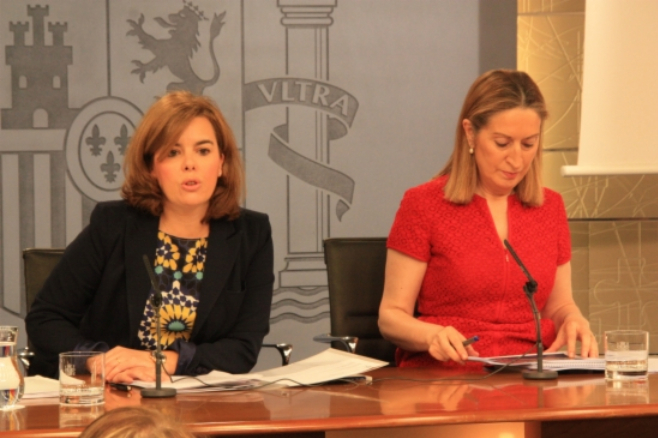
On Friday, the Spanish Government reacted to the publication by the Catalan Executive of the so-called “fiscal balances” for 2011, which calculate how much money citizens from Catalonia paid in taxes to the Spanish Government and how much they received back in terms of services, grants and investments. After the weekly cabinet meeting, the Spanish Deputy Prime Minister, Soraya Sáenz de Santamaría, stated that the Catalan Government is “making the calculations” that “are in its interest for the political message”. “All the elements have to be put on the table and with maximum transparency,” she added. The Spanish Executive has only published the figures once, in 2008 with data from 2005, not respecting the successive requests from Parliament and transparency standards. The Catalan Government has been calculating these figures for the last years, following the advice of independent university experts. Between 1986 and 2011, Catalans gave up an average of 8% of Catalonia’s GDP each year, an amount representing €16 billion per year in today’s money. This has been a very sensitive issue in Catalan and Spanish politics for decades, particularly during the self-determination debate.
On Friday morning, the Spanish Deputy Finance Minister, Antonio Beteta, stated that his team has not had the time to calculate these figures, which were initially announced to be released by last December. In addition, despite acknowledging he had no made the calculations, he stated that the fiscal deficit of the Madrid Region is “probably higher” than Catalonia’s. All the Spanish Government ministries, most of the agencies, and many multinational companies are based in Madrid and they pay their taxes in this region. In addition, the Spanish Government counts some portions of investments made in Madrid museums such as El Prado or Madrid Barajas airport as investments made for the whole of Spain, while they primarily benefit Madrid’s local economy.
On Thursday, the Catalan Government issued its so-called “fiscal balances.” According to the Catalan Finance Minister, Andreu Mas-Colell, Catalans funded services and infrastructure in the rest of Spain for €15 billion, equivalent to 7.7% of Catalonia’s GDP or €2,055 per citizen, using the cash flow method. Using the tax-benefit method, Catalonia contributed €11.1 billion, equivalent to 5.7% of its GDP. The two methods are “complementary”, Mas-Colell stated, although the first one makes less assumptions and is closer to reality in times of economic crisis and high unemployment. “Catalonia is a net and generous contributor” to the whole of Spain, he said. In fact, the figures for 2011 confirm Catalonia’s “sustained” negative “fiscal balance” for the 1986-2011 period, with an average 8.0% fiscal deficit.
Catalonia’s fiscal contributions have been a very sensitive issue for decades in Catalan and Spanish politics, particularly during the self-determination and independence debates of the last two years. However, the issue has been on the table for a very long while. An ample majority of Catalan society (including all business associations and most of the political parties) has been asking for decades to reduce such contribution levels while, at the same time, maintaining a certain degree of solidarity with poorer regions. However, the Spanish Government, regardless of the political party in power—the People’s Party (PP) or the Socialist Party (PSOE)—has always rejected significantly modifying this trend, which under-budgets public services in Catalonia and damages its economy and competitiveness.
A Fiscal Pact aiming to reduce such contributions
In this line, the President of the Catalan Government, Artur Mas, proposed to the Spanish Prime Minister Mariano Rajoy negotiating a Fiscal Pact for Catalonia, similar to the one the Basque Country and Navarre have. In this new Fiscal Pact, the Catalan Government would have the powers to collect all taxes and would transfer an amount to the Spanish Executive to pay for three basic concepts: general services, services and investments made in Catalonia, and solidarity contributions with poorer regions and countries. The main advantage of this is that the Catalan Executive would control the money and would know exactly how much was collected and how much was returned. The proposal for a new Fiscal Pact had been debated in Catalonia since 2010 and a group of political parties agreed to push for it in mid-2012. In September 2012, Artur Mas met with Mariano Rajoy a few days after the massive pro-independence demonstration that gathered 1.5 million people in Barcelona and proposed this new Fiscal Pact. Rajoy refused to even talk about it. Mas immediately called snap elections, citing that the Fiscal Pact that he had campaigned on was impossible to achieve.
The Spanish Government has only published the fiscal balances once in 37 years
There is a persistent lack of transparency regarding such figures at the Spanish level. Indeed some politicians outside Catalonia have downplayed or even directly denied the fact that Catalans are greatly contributing to fund poorer parts of Spain, or have accused Catalans outright of being greedy. The Spanish Government has only published such figures once in the 37 years of democracy. In 2008, the Spanish Finance Ministry stated that Catalonia had a fiscal deficit between 8.7% and 6.4% (depending on the calculation formula) in 2005, the only year included in the study. From that point forward, the Catalan Government started to publish its own calculations every year, including the accumulated figures since 1986, when there is comparable data available.
The current Spanish Government promised to publish the fiscal balances again but with a new methodology in December 2013. In January 2014, the Spanish Finance Minister, Cristóbal Montoro, stated that they would be published in March and he underlined that the previous methodology “was fueling independence arguments”. Meanwhile, many members of the academia criticized the decision to change a methodology that is used in other countries and designed with university experts. When March arrived, Montoro said the fiscal balances would be issued by June. At that time, Catalan business associations started to urge for issuing the fiscal balances with the two methodologies and criticized the Spanish Government for delaying their publication.
The fiscal deficit of 2011 would almost pay for the entire healthcare, education and social budgets
The Catalan Government, as it has been doing over the past few years each spring, is publishing its own calculation of the fiscal balances. With the cash flow formula, Catalans contributed €54.91 billion in 2011: €47.73 billion corresponding to revenue of 2011 and €7.19 billion corresponding to the debt generated this year (which will have to be paid in the coming years). The Spanish Government and associated bodies, including Social Security, spent €39.90 billion in Catalonia. This results in a negative balance of €15.01 billion, representing 7.7% of Catalonia’s entire GDP. In 2011, the Catalan Government spent €16.32 billion in healthcare, education and social welfare (considering it exclusively manages the entire health and education systems in Catalonia). In addition, the Spanish Government’s spending in Defense and Security (the military and police) reached €15.27 billion. Furthermore, in that year, Spain received a total of €13.27 billion from the European Union and contributed just €12.12 billion to the EU budget.