
02.05.2014 - 22:08
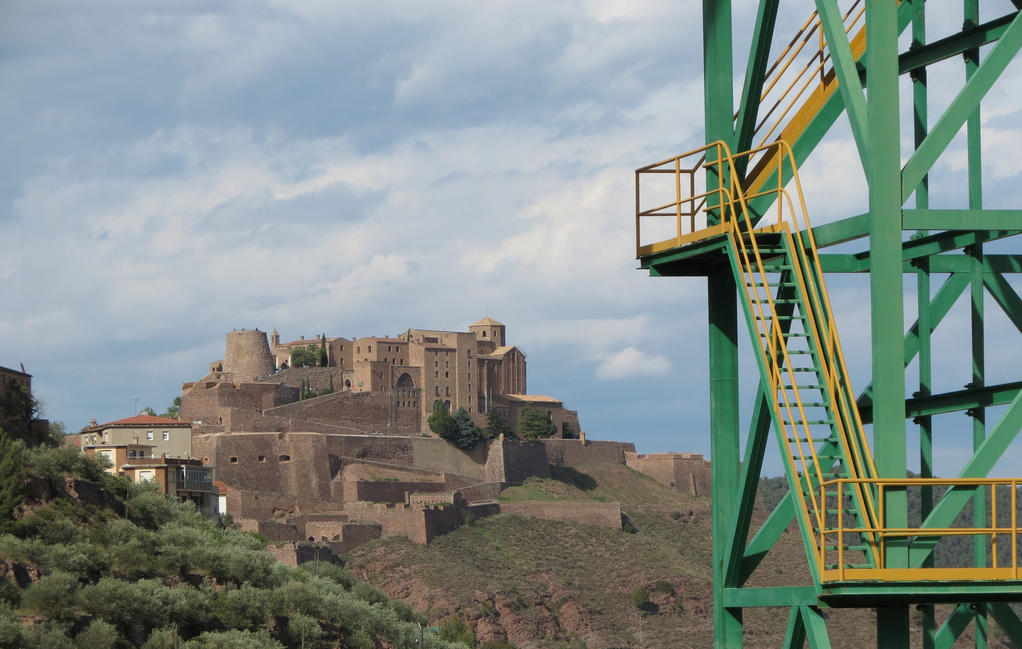
We went to Cardona for the salt. I had forgotten about the castle, even though it was the last bastion of the Catalan army in 1714. But when we approached, after a circuitous route along a beautiful country road, thanks to a wrong turn, it was the castle and not the old salt mines that grabbed our attention. It is an imposing fortress at the top of a small hill that overlooks both the town and the countryside below. Of course, the fortunes of the castle and the salt are intertwined, the former having been built between the 11th and 15th centuries precisely in order to protect the salt and those who had benefited from its riches. They were so wealthy, they were known as the “royalty without a crown”.

We took just a quick tour through the castle, admiring the orange-glassed oil lanterns that must have lit up fancy parties in the courtyard, and pondering over a huge stone bowl on display—“lots of soup?” we wondered.

Perhaps the best part of the castle, though, were the views down to the town below, whose streets were clearly outlined by the spaces between buildings and whose houses nestled around a church. We couldn’t tell yet what it looked like up close.

We could see the gaping hole in the ground and the bulldozers surrounding the “Mountain of Salt” which honestly looked a fair bit more like a “Hill of Salt”. But it was the caves that had first captured my attention, so I held my judgment. An over-ambitious parking lot greeted us, towered over by a incongruous green tower, fairly close to how you might imagine an abandoned mine shaft should look, but with a fresh coat of paint. We bought our tickets (10€ each) and ran toward the little bus that would take us to the mouth of the mine.

Our tour guide, after making us don hard hats and giving us a moment to photograph ourselves in them, admonished us to not take pictures until she gave the word (“who knows what would happen if people just did whatever they felt like”), not touch or pocket any rocks, and to keep our hardhats on, making us wonder if we were safe. Overhead, the ceiling of the entrance looked like a freezer in serious need of defrosting, but it was warm to the touch—and yes, salty. She began to explain.

The valley in which Cardona sits used to be covered by a huge sea, and the salt concentrated in and around a small area. Tectonic forces pushed the relatively malleable salt deposits higher and higher until the “Mountain of Salt” was formed. People have been cutting off chunks of the mountain for thousands of years, mostly because salt was necessary for keeping food from spoiling. It was so important that the Romans paid their soldiers in salt, a fact which is preserved in words like “salary”.

Around 1920, an engineer named Emili Viader visited the mine and discovered that not only was it a good source for regular old table salt, it also had important deposits of sylvite, or potassium chloride, which is used in explosive materials, batteries, and particularly fertilizer, and also magnesium chloride. They had to dig deep underground to reach these other specialized salts, up to 1308m (4291 feet) down, where the temperature reached as high as 50°C (122°F). After seeing the pictures of the workers wearing typical Catalan espadrille type fabric shoes, it was obvious that there was more story than what she was telling.

The inside of the caves is otherworldly. Though the caves are man-made, originally chiseled, later exploded with dynamite, and finally dug out by machines, the steady permeation of the rain through the mountain results in a forest of stalactites and stalagmites, that vary in color depending on the minerals dragged along with the salt and water. Our guide said the inside of the stalactites is basically hollow and on very rainy days, they get so heavy they sometimes fall down to the ground, hence the hard hats. Generally, though, the drips of water hang so long that the water evaporates and the remaining salt creates the next layer of the hanging salt-icle. If the drop hits the ground, the same process happens, but from the bottom up. Eventually the stalactites and the stalagmites meet in the middle, creating dense anemones of salt.

A little bus brought us back up the hill and deposited us at the gift shop, filled with dull little statuettes and Barça emblems made out of salt rock. It might be the first gift shop ever where my kids didn’t ask for a souvenir. Not sure if it’s the American in me that made me wonder why they weren’t selling “authentic Cardona kosher salt” in twelve different sizes and textures, salt and pepper grinders, t-shirts and posters, and kits for making your own salt stalactites.

In the cafeteria there was an exhibit of the “Memories of the Women of the Cardona Salt Mines”. There were pictures of the military style barracks where workers and their families were housed, alongside quotes which waxed nostalgic about having a proper home and running water, pictures of children running and playing, with captions like “annual July 18 celebration, 1952″, or the description of the company putting in running water and proper plumbing, only to turn off the water shortly after in favor of the miners’ wives hauling water from wells. And all of the surnames were Spanish, with some narrating the difficult trip up from the south of Spain where there was no work. The exhibit left me with so many questions. Where had the barracks been? Did the Spanish miners mix with the Catalan townspeople? Where were they now? How many people died in the mines? When did they stop wearing espadrilles? What will people do to protect their families?


Down in the big machinery building, filled with the enormous gears and engines that must have raised and lowered the men thousands of feet into the caves, there were more clues. A letter from the local chapter of the CNT-FAI, in Spanish, reassured the “petit bourgeoisie” that they had nothing to worry about as long as “they knew their place alongside the workers”. And a chronology detailed how many times the control of the mine changed hands through the twenties and thirties.

That gift shop would do well to stock a few books on local history.
If you go:
Cardona is an hour and 10 minutes northwest of Barcelona. Take one of the Rondas to the C16 and head out of Barcelona toward Manresa. In Manresa, take the Cardona exit and continue on C55. We actually missed the turn-off and continued on C16 until Navàs, when we realized our error. Instead of heading back, we took this tiny country rode across the mountain (BV-4235). It was narrow, but not so winding that it made any of us sick. The views were spectacular, and we passed an 11th century monastery along the way. All in all it added an extra forty minutes to the drive, but it was well worth it if you like going off the beaten track.
Cardona Castle – You can drive up and just walk around, or take a guided tour, or even stay in the hotel that now takes up part of the castle.
Cardona Mountain of Salt – The no longer functional Salt mine is on the far side of the town, follow signs for the “Muntanya de Sal”. They offer guided tours of the mine in Spanish and Catalan every half an hour, but we had to wait a while so I recommend getting tickets as soon as you’re in Cardona.